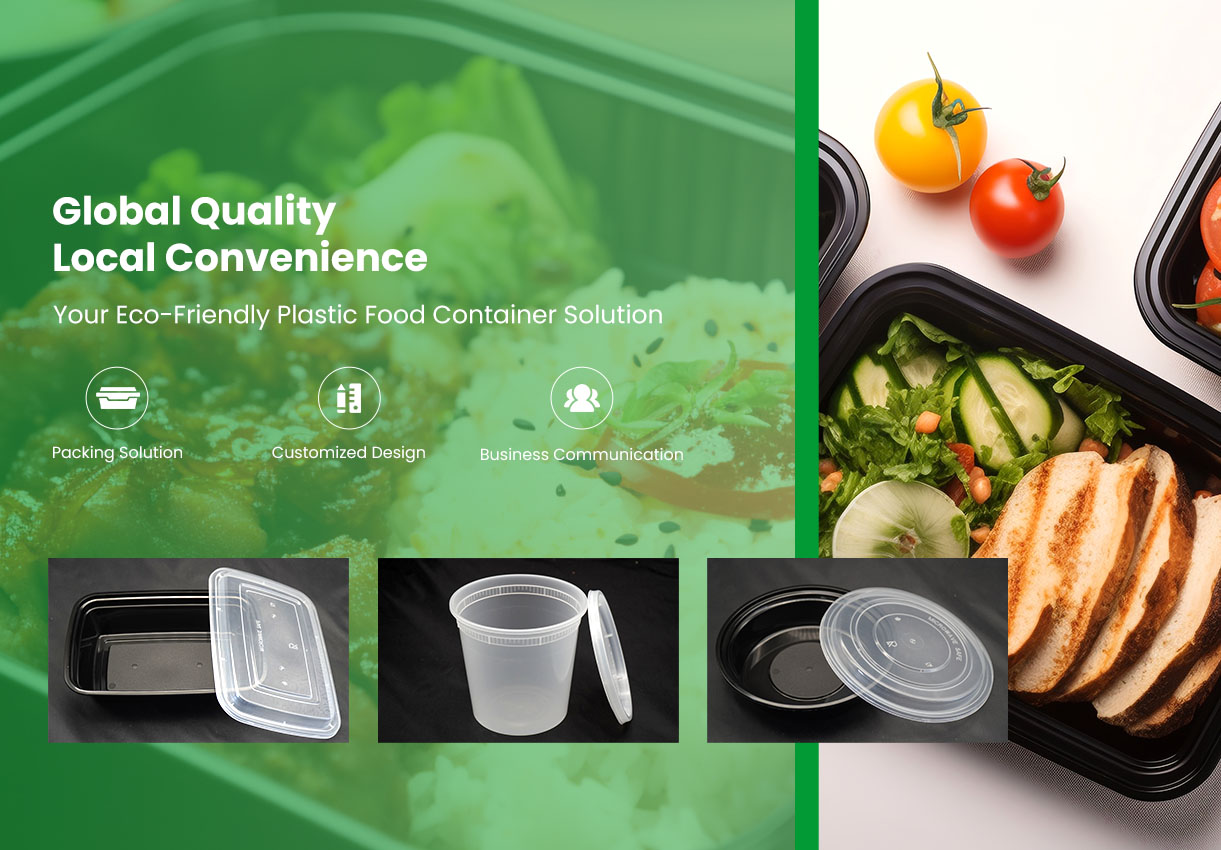
Microwave safety for disposable food containers depends on two things that are often ignored: the container material and the real heat conditions inside the pack. In a typical microwave cycle, water-based foods usually stay near 100°C, but fatty or sugary foods can locally exceed that, and hot spots can form where food touches the container wall. From a manufacturer’s perspective, “microwave safe” is not a slogan—it is the result of material selection, temperature design margin, and migration testing.
LVHUI focuses on disposable food packaging designed for everyday heating workflows, offering consistent material control, stable production, and documentation support that helps buyers standardize packaging across multiple SKUs and markets.
A disposable container can be considered microwave safe when it can meet three practical requirements:
Thermal stability The container must keep its shape and sealing performance at the expected heating temperature, including short bursts of higher surface temperature in hot-spot zones.
Low-risk chemical migration Food-contact plastics and coatings are expected to meet regulatory requirements for overall migration and specific substances. In the US, FDA food-contact compliance is commonly referenced through 21 CFR frameworks. In the EU, compliance is often aligned with Regulation (EC) No 1935/2004 and related migration requirements.
Safe-use instructions are realistic Even a compliant container can become unsafe if the user microwaves it empty, overheats oil-heavy food, or seals it fully with no venting.
Different disposable materials behave very differently under microwave energy and heat.
| Common container material | Typical heat tolerance range | Microwave suitability | What manufacturers watch closely |
|---|---|---|---|
| PP polypropylene | Up to about 120°C for many food-pack designs | Commonly suitable | Warping at corners, lid softening, odor control |
| CPET crystallized PET | Often designed up to about 200°C | Suitable for higher-heat use | Brittleness vs. impact resistance, seal integrity |
| PET standard | Lower heat tolerance, may deform with heat | Not recommended for heating | Distortion, seal failure, migration risk under abuse |
| Paper with barrier coating | Depends on coating and structure | Sometimes suitable | Coating softening, leakage, fiber swelling |
| Bagasse sugarcane fiber | Generally handles hot food well | Often suitable for reheating | Oil resistance, rim strength, moisture management |
| PLA bioplastic | Softens around 60°C range | Generally not suitable | Deformation, lid fit loss |
Data notes: PP melting point is commonly cited around 160–170°C in polymer references, but practical container performance is limited by wall thickness, design ribs, and additives, so real-use heat tolerance is lower than melting point. Microwave heating of water-rich foods typically stays near 100°C due to boiling limits, while oils can exceed that. Source basis: polymer engineering handbooks and general thermal behavior references; microwave heating behavior consistent with standard food science principles.
Foods like curry, cheese-heavy dishes, and oily soups can create localized high temperatures near the container wall. If a container is not designed for that load, the rim may soften, lids may lose fit, and the base may warp, increasing spill risk.
A fully sealed lid can trap steam and raise internal pressure. Even if the base material is stable, pressure can pop the lid, splash hot food, or distort the sealing edge. Practical packaging guidance typically recommends loosening the lid or using a vent feature when microwaving.
A microwave heats food; an oven heats the container directly with hot air. Confusing the two is a common failure mode. If your workflow includes oven finishing, the material selection must change.
From a production standpoint, microwave performance is engineered through material control + design + verification:
Material screening and lot consistency LVHUI controls incoming material specifications and production parameters so containers behave consistently across bulk order cycles, reducing “one batch good, next batch soft” problems.
Structural design for heat cycles Reinforced corners, rib patterns, and rim geometry help maintain shape under heat and load, especially for stacked meals in delivery or central kitchens.
Migration and safety documentation support For many buyers, the real challenge is not only the container—it is the paperwork trail for food-contact compliance and internal QA. LVHUI can support documentation alignment for different market requirements and project buyer checklists as a solution provider.
OEM/ODM packaging matching If you need a container series that matches lids, compartments, and portion sizes across multiple menu items, LVHUI can develop coordinated specs so your team is not managing incompatible SKUs.
These instructions reduce misuse and customer complaints while improving safety outcomes:
Heat in short cycles, stir when possible, and avoid prolonged overheating.
Loosen the lid or use a vented design to release steam.
Do not microwave empty containers.
Avoid microwaving with metal parts, metallic inks, or non-microwave-approved accessories.
If the meal is oil-heavy or sugar-heavy, recommend lower power or shorter cycles to reduce hot-spot risk.
When specifying products for repeat purchasing and scale, evaluate:
Target food temperature profile and whether meals are oil-heavy
Container wall thickness, rim strength, and stack load requirements
Lid fit at heat and after cooling
Leakage performance after reheating
Required compliance documentation for your destination market
Consistency across repeated production runs, not just one sample box
disposable food containers can be microwave safe, but only when material choice, heat tolerance, and migration compliance are treated as engineering requirements—not marketing terms. If your operation needs reliable reheating performance at scale, selecting a manufacturer that can control material consistency, container geometry, and verification routines is the safest path. LVHUI supports microwave-oriented disposable packaging with stable production capability, coordinated specification development, and documentation assistance that helps standardize your packaging system across different meal types and use conditions.